
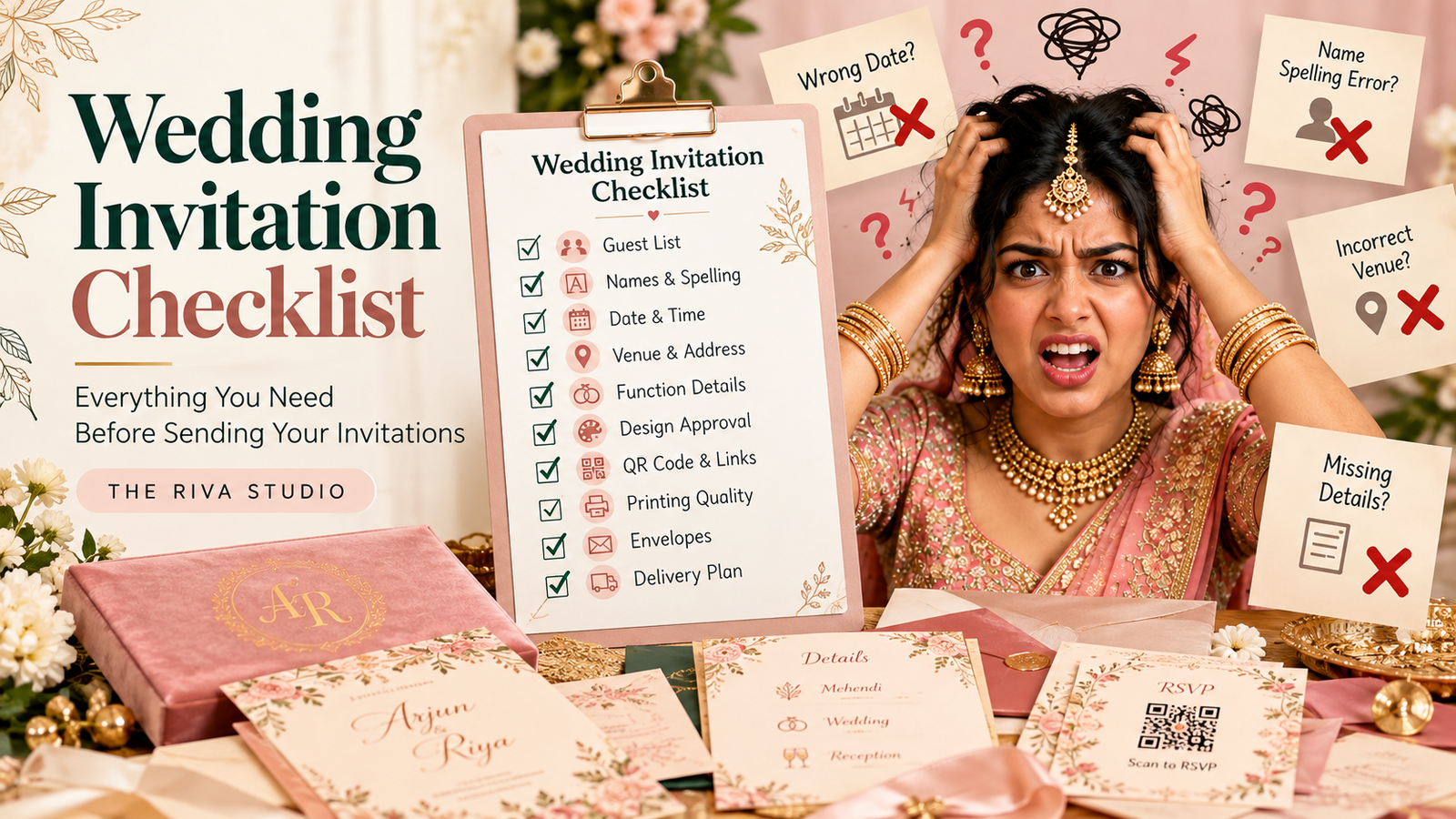
The Riva Studio
Planning a wedding involves hundreds of small details, and your invitation is one of the most important. It tells your guests when to come, where to go, what celebrations to expect, and how to respond.
But wedding invitations can easily go wrong. A misspelled name, incorrect date, wrong venue address, missing function, or insufficient number of cards can create unnecessary stress.
That is why a wedding invitation checklist is useful before you approve the final design or send your invitations to print.
This guide from The Riva Studio covers everything you should check, from your guest list and invitation wording to printing, envelopes, QR codes, delivery, and final proofreading.
Quick Answer: What Should You Check Before Sending a Wedding Invitation?
Before sending your wedding invitations, check your guest list, names, wedding dates, timings, venue addresses, function details, invitation wording, RSVP information, contact numbers, maps or QR codes, spelling, printing quality, envelopes, and delivery details.
Always review the final proof carefully and ask another person to check it before printing.
A good wedding invitation checklist helps you catch small mistakes before they become expensive printing or delivery problems.
Complete Wedding Invitation Checklist
Use this checklist before approving your final wedding invitation.
Guest Details
- Final guest list completed
- Names checked and correctly spelled
- Family and household names confirmed
- Correct number of invitations calculated
- Extra invitations included
- VIP and close-family invitations identified
Wedding Details
- Couple’s names checked
- Wedding date confirmed
- Wedding time confirmed
- Venue name confirmed
- Full venue address included
- All wedding functions listed
- Function dates and timings checked
- Dress code added if required
- RSVP information included
- Contact numbers checked
Design Details
- Invitation design approved
- Colours finalised
- Fonts are readable
- Text is properly aligned
- Illustrations and photographs are approved
- Religious or cultural symbols are correct
- Regional-language text checked
- Personalised details checked
Practical Information
- Google Maps location checked
- QR code tested
- RSVP link tested
- Website link tested
- Accommodation details added if required
- Parking information added if required
- Transportation details added if required
Production
- Final proof approved
- Paper selected
- Printing method confirmed
- Envelope size confirmed
- Envelope quantity checked
- Extra copies ordered
- Addressing method confirmed
- Delivery timeline confirmed
1. Finalise Your Guest List First
Your guest list should be finalised before you place your invitation order.
This is because invitations are usually counted by invitation units, not simply by the number of guests.
For example, if a family of four is receiving one invitation, you need one invitation for that household rather than four separate cards.
Create separate categories such as:
- Immediate family
- Extended family
- Friends
- Colleagues
- Neighbours
- Family friends
- Out-of-town guests
- Special guests
This makes it easier to calculate the correct quantity.
How Many Extra Invitations Should You Order?
It is useful to keep some additional invitations for:
- Last-minute additions
- Damaged cards
- Forgotten guests
- Keepsakes
- Family members who need additional copies
- Future reference
Ordering a few extras can be much easier than reprinting a small batch later.
2. Check Every Name Carefully
Names are one of the most important parts of a wedding invitation.
Check:
- Bride’s name
- Groom’s name
- Parents’ names
- Grandparents’ names
- Hosts’ names
- Family names
- Special guest names
Pay extra attention to names written in Tamil or another regional language.
A name may look correct in English but contain a spelling or character error in another script.
If your invitation contains multiple languages, ask someone who can confidently read each language to proofread it.
This is one of the most important steps in your wedding invitation checklist.
3. Confirm the Wedding Date and Time
Double-check the exact:
- Wedding date
- Reception date
- Engagement date
- Mehendi date
- Haldi date
- Sangeet date
- Other celebration dates
- Ceremony timings
- Reception timings
If different events happen on different days, make sure every date is clearly connected to the correct function.
Do not rely only on memory. Compare the invitation with your final wedding schedule.
4. Verify the Venue and Address
Your venue information needs to be accurate because guests may use the invitation while travelling.
Check:
- Venue name
- Building or hall name
- Street
- Area
- City
- Pin code
- Landmark
- Google Maps location
If your venue has multiple entrances or halls, mention the correct entrance or hall where necessary.
For destination weddings, consider adding:
- Hotel information
- Check-in details
- Transportation information
- Parking information
- Local contact number
5. Include All Wedding Functions
Indian weddings can include several celebrations, so make sure you do not accidentally leave one out.
Depending on your wedding, your invitation may include:
- Engagement
- Haldi
- Mehendi
- Sangeet
- Wedding ceremony
- Reception
- Breakfast
- Lunch
- Dinner
- Family gathering
- Post-wedding celebration
Before printing, compare your invitation with your complete wedding event schedule.
6. Check Your Invitation Wording
Your wording should match the tone and style of your wedding.
A traditional wedding may use formal wording, while a modern celebration may use shorter and more personal language.
Check:
- Opening message
- Couple’s names
- Parents’ names
- Host names
- Invitation sentence
- Function descriptions
- Date and time
- Venue
- RSVP
- Closing message
Read the complete invitation from beginning to end rather than checking individual sections separately.
Sometimes a sentence can look correct on its own but sound awkward when read together.
7. Test Every QR Code and Link
Many modern wedding invitations include QR codes.
You may use them for:
- Google Maps
- RSVP
- Wedding website
- Event schedule
- Digital album
- Accommodation information
- Gift registry
Do not assume that a QR code works simply because it appears correctly in the design.
Scan it using multiple phones and confirm that it opens the correct destination.
Also check that the destination page works properly on mobile.
A broken QR code can make an otherwise beautiful invitation frustrating for guests.
8. Review the Invitation Design
Once the content is correct, review the visual design.
Check:
Typography
- Are the fonts readable?
- Are important details large enough?
- Is the text hierarchy clear?
- Are decorative fonts being used only where appropriate?
Colours
- Do the colours match your wedding theme?
- Is there enough contrast between the text and background?
- Are important details easy to read?
Layout
- Is the invitation overcrowded?
- Is there enough spacing?
- Are the margins consistent?
- Are all elements aligned?
Images and Illustrations
- Are photographs high quality?
- Are illustrations correctly positioned?
- Are cultural or religious elements represented appropriately?
- Are there any unwanted marks or objects?
9. Choose the Right Paper and Printing Finish
The paper and printing technique can significantly change how an invitation feels.
Depending on your design, you may consider:
- Textured paper
- Handmade paper
- Cotton paper
- Matte paper
- Premium card stock
- Foil printing
- Embossing
- Letterpress
- Digital printing
Your paper choice should work with your design rather than being selected separately.
For example, a detailed traditional illustration may require a paper that allows fine printing, while a minimal modern invitation may work beautifully with a clean textured stock.
10. Check Your Envelopes
The envelope is part of the invitation experience.
Check:
- Envelope size
- Envelope colour
- Guest name
- Address
- Return address if required
- Postage requirements
- Quantity
- Envelope design
If you are using customised envelopes, make sure the names and addresses are checked separately from the invitation itself.
11. Calculate How Many Wedding Invitations You Need
One of the most common planning mistakes is ordering invitations based on the total number of guests.
Instead, calculate the number of households or invitation recipients.
For example:
250 guests ≠ necessarily 250 invitations.
If some guests are attending as families or couples, one invitation may cover multiple people.
Create a final count based on:
Households + individual guests + special copies + extra invitations
This gives you a more realistic quantity.
12. Plan Your Wedding Invitation Timeline
Do not leave your invitations until the final weeks before your wedding.
A practical timeline can look like this:
| Stage | Suggested Timing |
|---|---|
| Finalise guest list | 10–12 weeks before |
| Finalise invitation content | 10–12 weeks before |
| Approve design | 8–10 weeks before |
| Approve final proof | 8–10 weeks before |
| Printing | 6–8 weeks before |
| Prepare envelopes | 6–8 weeks before |
| Begin delivery | 6–8 weeks before |
| RSVP deadline | Around 3–4 weeks before |
Your actual timeline can change depending on the size and location of your wedding.
If you are ordering customised wedding invitations, allow additional time for design revisions, proofing, printing and finishing.
13. Check Your Invitation Proof Before Printing
Never approve a wedding invitation based only on the designer’s preview.
If possible, review the final proof carefully before production.
Look for:
- Spelling mistakes
- Missing words
- Incorrect dates
- Incorrect timings
- Wrong addresses
- Incorrect phone numbers
- Missing functions
- Formatting problems
- Colour differences
- QR-code errors
- Regional-language mistakes
Read every line.
Do not assume someone else has already checked it.
14. Get a Second Person to Proofread
A second pair of eyes can catch mistakes that you may no longer notice.
Ask someone who is familiar with the wedding details to check:
- Names
- Dates
- Times
- Venues
- Addresses
- Function names
- Contact details
- Language
- QR codes
Ideally, give them a fresh copy rather than explaining what they should look for.
This makes it easier for them to notice errors independently.
15. Plan Your Invitation Delivery
Once the invitations are printed, you still need to plan how they will reach your guests.
Separate your guest list into:
- Chennai/local guests
- Outstation guests
- International guests
- Family members
- Special guests
Local invitations can often be hand-delivered.
For outstation and international guests, allow extra time for delivery.
Keep track of invitations that have already been delivered so that you do not accidentally send duplicates.
16. Consider Digital and Physical Invitations Together
Many couples now use both physical and digital invitations.
A physical invitation can provide the traditional wedding experience, while a digital invitation makes sharing information easier.
You can use digital invitations for:
- Family groups
- Outstation guests
- International guests
- Last-minute updates
A digital version can also include clickable maps, RSVP links and additional event information.
17. Personalise Your Wedding Invitation
Your invitation should feel connected to your wedding.
Personalisation can include:
- Couple illustrations
- Family details
- Cultural motifs
- Custom monograms
- Wedding hashtags
- Venue illustrations
- Personal messages
- Custom colour palettes
- Regional design elements
At The Riva Studio, personalised wedding invitations can be designed around the couple’s celebration rather than using a generic template.
The goal is not simply to make an invitation look attractive. It should feel like a preview of the wedding itself.
18. Don’t Forget the Small Details
Some of the easiest things to miss are the smallest ones.
Before sending your invitations, check:
- Pin code
- Phone number
- Email address
- Instagram handle
- Wedding website
- Hashtag
- QR code
- RSVP deadline
- Parking details
- Dress code
- Accommodation details
These details may not seem important during design, but they can be extremely useful to guests.
Final Wedding Invitation Checklist Before You Send
Before your invitations leave your hands, go through this final list:
Content
☐ Couple’s names correct
☐ Parents’ names correct
☐ Dates correct
☐ Times correct
☐ Venue correct
☐ Address correct
☐ All functions included
☐ RSVP information included
☐ Contact details correct
Design
☐ Spelling checked
☐ Regional-language text checked
☐ Colours approved
☐ Fonts readable
☐ Images high quality
☐ Layout aligned
☐ Final proof approved
Digital Information
☐ QR code tested
☐ Google Maps link tested
☐ RSVP link tested
☐ Wedding website tested
Production
☐ Paper selected
☐ Printing approved
☐ Envelope size confirmed
☐ Guest names checked
☐ Quantity confirmed
☐ Extra copies ordered
Delivery
☐ Local guest list organised
☐ Outstation guest list organised
☐ International guest list organised
☐ Delivery method confirmed
☐ Invitations tracked
If every box is checked, your invitation is ready to go.
Common Wedding Invitation Mistakes to Avoid
1. Printing Before Final Proofing
Never send a design to print before checking every detail.
2. Ordering Too Few Invitations
Always calculate invitations based on households and recipients, then keep additional copies.
3. Forgetting a Wedding Function
Compare your invitation with your final event schedule.
4. Not Testing QR Codes
A QR code that looks correct may still lead to the wrong page.
5. Using Hard-to-Read Fonts
Beautiful typography is useful only when guests can easily read the information.
6. Leaving Out Practical Information
Maps, parking, accommodation and RSVP information can make the invitation much more useful.
7. Not Checking Regional-Language Text
If your invitation contains Tamil, Hindi, Telugu, Malayalam or another language, have a fluent reader proofread it.
Frequently Asked Questions
What should be included in a wedding invitation?
A wedding invitation should generally include the couple’s names, hosts or family names where relevant, wedding date, time, venue, function details and RSVP information. Additional information such as maps, QR codes, accommodation and dress code can also be included when useful.
When should I order wedding invitations?
It is better to begin the invitation process several weeks before the wedding. You need time for content finalisation, design, proofing, printing, finishing, envelope preparation and delivery.
How many wedding invitations should I order?
Calculate invitations based on households or invitation recipients rather than simply counting individual guests. Keep additional copies for last-minute additions and unexpected requirements.
Should I send both physical and digital invitations?
You can use both. Physical invitations provide a traditional keepsake, while digital invitations are convenient for WhatsApp, email, outstation guests and international guests.
Should I include a QR code on my wedding invitation?
A QR code can be useful for Google Maps, RSVP forms, wedding websites, event schedules and accommodation information. Always test it before printing.
How can I avoid mistakes in my wedding invitation?
Use a wedding invitation checklist, proofread the complete invitation carefully, compare all details with your wedding schedule, and ask a second person to review the final proof before printing.
Can The Riva Studio customise wedding invitations?
Yes. The Riva Studio can be positioned around customised wedding invitations and coordinated wedding stationery, allowing the invitation design to reflect the couple’s wedding theme, colours and celebration style.
Why Choose The Riva Studio for Your Wedding Invitations?
Your wedding invitation is more than a card. It is one of the first things your guests experience before your celebration begins.
At The Riva Studio, the focus is on creating wedding invitations and stationery that feel personal, polished and connected to the couple’s celebration.
From the invitation design to matching stationery and return gifts, keeping the visual language consistent can create a more complete wedding experience.
If you are planning a wedding in Chennai and want a personalised invitation that fits your celebration, The Riva Studio can help you plan the design, details and supporting stationery together.
Final Thoughts
A beautiful wedding invitation is important, but a correct and well-planned invitation is even more important.
Before you send your invitations, take time to check the guest list, names, dates, venues, functions, wording, QR codes, printing, envelopes and delivery details.
Use this wedding invitation checklist from the beginning of your invitation process and again before the final invitations are sent.
A few extra minutes of proofreading can save you from expensive reprints and unnecessary last-minute stress.
Your invitation should give your guests everything they need while giving them their first glimpse of your wedding celebration.
For customised wedding invitations, coordinated wedding stationery and personalised wedding details, explore The Riva Studio.