
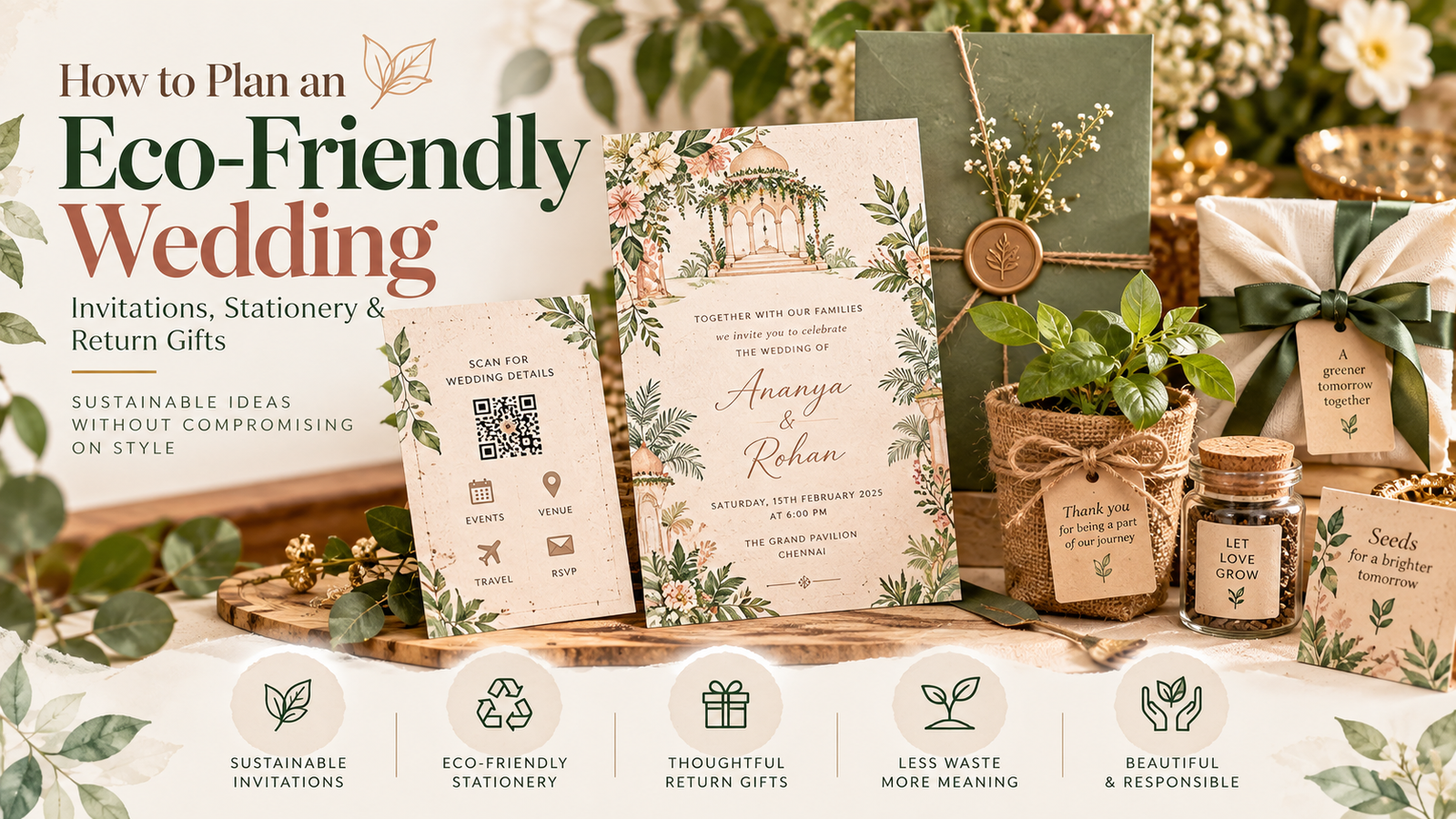
Weddings are full of beautiful details, from invitations and stationery to decorations, packaging and return gifts. But with so many things being printed, packed, transported and discarded, it is also worth thinking about how much waste a celebration can create.
The good news is that planning an eco-friendly wedding does not mean giving up beautiful invitations, stylish stationery or thoughtful return gifts.
With a few conscious choices, couples can reduce unnecessary waste while still creating a wedding that feels personal, elegant and memorable.
From choosing sustainable invitation materials to reducing excess packaging and selecting useful return gifts, there are many ways to make your celebration more environmentally responsible.
In this guide, The Riva Studio explores practical ideas for planning an eco-friendly wedding, with a focus on invitations, wedding stationery and return gifts
What Is an Eco-Friendly Wedding?
An eco-friendly wedding is a celebration planned with greater attention to resource use, waste and unnecessary consumption.
Instead of trying to make every single wedding detail perfectly sustainable, couples can focus on practical changes such as:
- Reducing unnecessary printing
- Choosing recyclable or responsibly sourced materials
- Avoiding excessive packaging
- Using digital information where appropriate
- Choosing reusable or useful wedding items
- Supporting local vendors
- Selecting thoughtful return gifts
- Avoiding products that are likely to be discarded immediately
An eco-friendly wedding can still be luxurious, colourful, traditional and beautifully designed.
The goal is to make more conscious choices without losing the personality of the celebration.
Why Consider an Eco-Friendly Wedding?
Indian weddings often involve multiple events, invitations, gift packaging, stationery, decorations and guest favours.
This creates many opportunities to reduce unnecessary waste.
For example, instead of printing several cards containing information that could easily be shared digitally, couples can combine essential information into one invitation and use a QR code for additional details.
Instead of choosing decorative packaging that guests may throw away, couples can select reusable boxes, fabric bags or useful containers.
Small decisions across different parts of the wedding can make a meaningful difference.
1. Start With Your Wedding Invitations
Your wedding invitation is one of the easiest places to begin.
Traditional invitations can include several layers:
- Main invitation card
- Function cards
- RSVP card
- Map card
- Details card
- Envelope
- Decorative wrapping
- Box
- Ribbon
- Additional inserts
Not every wedding needs all of these elements.
For an eco-friendly wedding, start by asking:
Does this element provide useful information or is it only decorative?
If something can be removed without affecting the guest experience, consider removing it.
A simpler invitation can also look more modern and elegant.
2. Consider Recycled or Sustainable Paper
Paper selection is one of the most important decisions when designing wedding invitations.
Depending on availability and the design, couples can explore options such as:
- Recycled paper
- Handmade paper
- Recycled cotton paper
- Seed paper
- FSC-certified paper
- Other responsibly sourced paper options
Always ask your printer or invitation designer about the actual material and its disposal or recycling properties rather than assuming that a paper is sustainable simply because it looks natural.
For an eco-friendly wedding, choosing the right paper can be a simple first step.
3. Explore Seed Paper Invitations
Seed paper invitations are a popular option for couples looking for something different.
Some seed papers contain embedded seeds and are designed to be planted after use.
The concept gives the invitation a second purpose rather than treating it only as a piece of paper.
However, if you choose seed paper, check:
- What seeds are included
- Whether they are suitable for the intended location
- How the paper should be planted
- Whether the paper is compatible with your printing method
You should also avoid making environmental claims without confirming them with your supplier.
4. Choose a Minimal Invitation Design
Sustainable design does not have to look plain.
A thoughtfully designed invitation can feel luxurious while using fewer materials.
Consider:
- One well-designed invitation card
- Minimal inserts
- Simple envelopes
- Less decorative packaging
- Clean typography
- Elegant illustrations
- A restrained colour palette
A minimal design can also make important information easier for guests to read.
For a modern eco-friendly wedding, less can often become more.
5. Use Digital Invitations Alongside Physical Invitations
Digital invitations can reduce the amount of physical material required for some guests.
You do not necessarily have to choose between physical and digital invitations.
You can combine both.
For example:
Physical invitation:
Give a beautiful printed invitation to close family, important guests and people who appreciate physical keepsakes.
Digital invitation:
Share a digital version with friends, colleagues, outstation guests or guests who prefer WhatsApp and email.
This approach can help reduce the total number of physical invitations you need to produce.
6. Add a QR Code Instead of Multiple Insert Cards
A QR code can provide additional information without requiring several printed cards.
You can use it for:
- Google Maps
- RSVP
- Wedding website
- Event schedule
- Accommodation information
- Travel information
- Dress code
- Digital wedding programme
For example, instead of printing a separate map card and accommodation card, you could include a small QR code labelled:
Scan for wedding details
Before printing, always test the QR code and make sure the destination works correctly on mobile devices.
7. Reduce Excessive Invitation Packaging
Luxury wedding invitations sometimes come with multiple layers of packaging.
You may have:
Invitation box → fabric wrapping → ribbon → envelope → insert cards → decorative accessories.
While beautiful, not every layer is necessary.
For an eco-friendly wedding, consider asking:
- Can the box be reused?
- Can the packaging be recycled?
- Is the wrapping necessary?
- Can one material replace several layers?
- Will the guest have a use for the packaging later?
A beautiful reusable box can be more meaningful than several decorative layers that are immediately discarded.
8. Choose Reusable Wedding Stationery
Wedding stationery includes many items beyond invitations.
Examples include:
- Welcome signs
- Table numbers
- Menu cards
- Place cards
- Tent cards
- Bar menus
- Programme cards
- Thank-you cards
- Seating charts
- Gift tags
Whenever possible, consider whether an item can be reused.
For example, a beautifully designed acrylic, wood or framed welcome sign may be repurposed after the wedding.
However, the material should still be chosen carefully. Reusability does not automatically make every material environmentally friendly.
9. Reduce Single-Use Printed Items
Before ordering large quantities of stationery, estimate what you actually need.
Ask:
Does every guest need an individual copy?
For example, instead of placing a separate printed menu at every seat, you could explore:
- Shared table menus
- Reusable menu boards
- Digital menus
- Fewer printed inserts
The right solution depends on the type and scale of your wedding.
The goal is to avoid printing simply because there is space to fill.
10. Choose Eco-Friendly Envelopes
Your envelope is part of your invitation too.
You can explore:
- Recycled paper envelopes
- Handmade paper envelopes
- Minimal printed envelopes
- Paper-based closures
- Simple envelope liners
- Reusable packaging
If you use decorative liners, ask whether they can be made from recyclable or leftover paper.
A simple envelope can still look premium when paired with good typography, beautiful paper and thoughtful finishing.
11. Think About Printing Methods
Printing choices can affect the materials used in your invitation.
Discuss available options with your printer and ask about:
- Ink type
- Paper source
- Printing process
- Foil usage
- Finishing materials
- Production waste
- Recycling or disposal
You do not have to eliminate every premium finish.
Instead, decide which details genuinely add value to your invitation.
For example, a small amount of foil used intentionally may create a beautiful result without covering the entire invitation in decorative finishes.
12. Choose Local Wedding Vendors
Choosing local vendors can simplify logistics and may reduce unnecessary transportation compared with sourcing every item from distant suppliers.
For your invitations and stationery, consider working with designers and printers who are close to your wedding location.
Ask vendors about:
- Where materials are sourced
- Where printing takes place
- Whether production is done locally
- How excess materials are handled
- Whether reusable or recycled materials are available
For couples planning an eco-friendly wedding in Chennai, working with local wedding designers and suppliers can also make communication and proofing easier.
13. Make Your Wedding Return Gifts More Sustainable
Return gifts are another major part of wedding planning.
Instead of choosing something only because it looks attractive, think about whether your guests will actually use it.
Some ideas include:
- Reusable cloth bags
- Plantable gifts
- Small potted plants
- Reusable containers
- Handmade candles
- Useful kitchen items
- Artisan products
- Locally made products
- Reusable travel accessories
- Personalised fabric pouches
The best choice depends on your guests, budget and wedding style.
A useful gift is less likely to become an unwanted object sitting in a cupboard.
14. Choose Return Gifts With Less Packaging
Sometimes the packaging becomes larger than the actual gift.
For an eco-friendly wedding, consider reducing unnecessary:
- Plastic wrapping
- Multiple boxes
- Synthetic ribbons
- Plastic fillers
- Disposable decorative accessories
Instead, consider:
- Paper packaging
- Fabric pouches
- Reusable boxes
- Paper tags
- Natural-fibre elements
- Minimal wrapping
The packaging itself can become part of the gift.
For example, a reusable fabric pouch can hold a small gift and continue to be used after the wedding.
15. Give Plants as Wedding Return Gifts
Plants can be a meaningful option for couples who want their return gifts to connect with nature.
Depending on the climate and guest lifestyle, options may include:
- Small indoor plants
- Herb plants
- Succulents
- Native plants
- Seed kits
If choosing plants, consider whether your guests can realistically care for them.
A gift should be practical for the people receiving it.
16. Support Local Artisans
An eco-friendly wedding can also be an opportunity to support local makers.
Instead of mass-produced gifts, consider sourcing return gifts from local artisans or small businesses.
Possible options include:
- Handmade pottery
- Handcrafted candles
- Local food products
- Handwoven products
- Artisan soaps
- Handmade decor
- Traditional crafts
This can also make your wedding favours feel more personal and connected to your culture.
17. Make Your Wedding Stationery Multi-Purpose
One useful sustainability principle is to make one item serve more than one purpose.
For example:
Invitation + keepsake
Gift box + storage box
Fabric pouch + return-gift packaging
Welcome sign + home decor
Wedding card + framed artwork
When an item continues to have a purpose after the wedding, it is less likely to become immediate waste.
18. Choose Digital RSVPs
Traditional RSVP cards require additional printing and handling.
A digital RSVP can be simpler.
You can create a QR code that takes guests to an RSVP form where they can provide:
- Name
- Number of guests
- Attendance confirmation
- Meal preference
- Travel requirements
- Accommodation requirements
This can also make it easier for the couple to organise guest information.
19. Don’t Make Sustainability Complicated
You do not have to completely redesign your wedding to make it more environmentally conscious.
Start with the areas where you can make practical changes.
For example:
Invitation:
Choose recycled paper.
Information:
Use a QR code.
Stationery:
Reduce unnecessary printed pieces.
Packaging:
Choose reusable materials.
Return gifts:
Choose useful products.
Vendors:
Explore local suppliers.
Five practical changes can be more realistic than trying to make every wedding detail perfect.
20. Eco-Friendly Does Not Mean Boring
One common misconception is that sustainable weddings have to look rustic or minimal.
That is not true.
An eco-friendly wedding can still be:
- Traditional
- Colourful
- Luxurious
- Modern
- Minimal
- Maximalist
- Floral
- Royal
- Contemporary
Sustainability is about the choices behind the design, not one particular visual style.
You can have a beautiful Indian wedding invitation with traditional motifs, rich colours and elegant typography while still making thoughtful material and packaging choices.
Eco-Friendly Wedding Checklist
Before finalising your invitations, stationery and return gifts, use this checklist.
Invitations
☐ Choose an appropriate paper
☐ Explore recycled or responsibly sourced materials
☐ Consider digital invitations
☐ Reduce unnecessary inserts
☐ Test QR codes
☐ Choose minimal packaging
☐ Proofread before printing
Wedding Stationery
☐ Print only what is needed
☐ Consider reusable signs
☐ Reduce single-use stationery
☐ Explore digital information
☐ Choose appropriate materials
☐ Avoid unnecessary decorative elements
Return Gifts
☐ Choose useful gifts
☐ Explore local products
☐ Consider reusable packaging
☐ Reduce plastic packaging
☐ Consider plants or seed-based gifts
☐ Choose gifts appropriate for your guests
Vendors
☐ Ask about material sources
☐ Ask about printing methods
☐ Ask about production waste
☐ Consider local suppliers
☐ Discuss sustainable alternatives
How Much Does an Eco-Friendly Wedding Cost?
An eco-friendly wedding does not automatically mean a cheaper wedding.
Some sustainable materials and handmade products may cost more than conventional alternatives.
However, reducing unnecessary elements can also help control costs.
For example, you may save by:
- Printing fewer cards
- Reducing packaging
- Combining information into one card
- Using digital invitations for some guests
- Choosing reusable stationery
- Buying directly from local makers
Instead of thinking about sustainability only as a cost-saving exercise, consider the overall value of what you are purchasing.
How The Riva Studio Can Help With an Eco-Friendly Wedding
At The Riva Studio, wedding invitations, stationery and return gifts can be planned as part of one coordinated visual experience.
If you are interested in an eco-friendly wedding, you can discuss options such as:
- Minimal invitation designs
- Digital and physical invitation combinations
- Custom wedding stationery
- Reduced packaging
- Personalised return gifts
- Reusable gift packaging
- Coordinated stationery
- Thoughtful material choices
The goal is to create wedding details that feel personal and beautiful while being more conscious about unnecessary waste.
Frequently Asked Questions
What is an eco-friendly wedding?
An eco-friendly wedding is planned with greater attention to materials, waste, packaging, transportation and unnecessary consumption. Couples can make more sustainable choices across invitations, stationery, decorations, food, gifts and other wedding details.
How can I make my wedding invitations eco-friendly?
Consider recycled or responsibly sourced paper, fewer inserts, minimal packaging, digital invitations and QR codes for additional information.
Are seed paper wedding invitations eco-friendly?
Seed paper can be an interesting alternative, but its environmental benefits depend on the paper, seeds, production process and how it is used. Ask your supplier for specific material information before making sustainability claims.
Can an eco-friendly wedding still look luxurious?
Yes. Sustainability does not require a particular aesthetic. Elegant typography, beautiful paper, thoughtful layouts and carefully selected finishes can create a premium look while reducing unnecessary materials.
What are good eco-friendly wedding return gifts?
Useful and reusable products can be good options. Depending on your guests, you could consider plants, seed kits, handmade products, reusable pouches, locally made products or other items that are likely to be used.
How can I reduce wedding invitation waste?
Start by estimating the actual number of invitations needed, avoiding unnecessary inserts, using digital information where appropriate, reducing excessive packaging and ordering only a reasonable number of extra copies.
Can I have both physical and digital wedding invitations?
Yes. Many couples can use physical invitations for selected guests and digital invitations for others. This can reduce the number of physical invitations required while keeping the traditional invitation experience for important guests.
Final Thoughts
Planning an eco-friendly wedding does not mean compromising on beauty, tradition or celebration.
It means becoming more intentional about what you buy, print, package and give.
Start with your wedding invitations. Choose materials carefully, avoid unnecessary inserts and consider using digital information.
Then look at your stationery. Print only what is useful and explore reusable options.
Finally, think about your return gifts. Choose something your guests can actually use, and consider reducing unnecessary packaging.
Even small decisions can make your wedding more thoughtful.
At The Riva Studio, the idea is simple: your wedding details should feel beautiful, personal and meaningful. With the right choices, they can also be more conscious of the resources and materials used to create them.
Your wedding is a celebration of a new beginning. Making thoughtful choices along the way can make the celebration feel even more meaningful.